

Tree-mendous Traditions: Exploring the Role of Forests in the Holiday Celebrations

Written by Sabrina Dookie

The holiday season is here once again! This time of the year allows us to reflect upon traditions and celebrations while fostering peace, joy, togetherness, and happiness. If we look a little closer beyond the sparkling lights and festivities, we can see that at the heart of many celebrations is nature itself. Trees remain an everlasting symbol, but nature’s role in holiday traditions goes far beyond decorations and gift-giving. Trees and plants from many forests worldwide are tied into seasonal celebrations across different cultures, playing a vital role in connecting us to nature itself. The Christmas tradition of bringing evergreen trees indoors dates back centuries, serving as a symbol of life, hope, and renewal. This practice originated in ancient cultures, was credited by the Germans in the 16th century, and was later embraced by Europeans, who transformed it into the popular custom we embrace today [1]. This tradition eventually spread to other countries on both the eastern and western hemispheres. Evergreen trees, resilient against harsh conditions, symbolise endurance and the promise of changing seasons. Some popular trees used by many cultures as Christmas trees include Abies fraseri (Fraser Fir), Abies procera (Noble Fir), Pseudotsuga menziesii (Douglas Fir), Picea pungens (Blue Spruce), Picea abies (Norway Spruce), Pinus spp. (Pine trees), and Araucaria spp. [2]. Forestry products find their way into holiday celebrations through a variety of cherished gifts which often demonstrate excellent craftsmanship, the beauty of wood and other forest-derived materials. These include handcrafted wooden toys, artisanal wooden utensils (carved spoons, ladles, cutting boards, etc.), forest-themed ornaments, scented soaps and candles (with natural scents like pine or cedar), wooden jewellery and accessories, treats such as cookies, biscuits and cakes made with nuts, seeds and seasonings, and holiday wreaths and garlands [3].
Forestry–related products often find their way into our homes during the festive season and have become a part of many traditions worldwide (Photos: (Left)PxHere distributed under a CC0 license, (Right) Pix4Free distributed under a CC0 domain license)
Various cultures globally observe the Christmas season, while others incorporate trees and forestry products in their year-end celebrations to ring in the new year! During the Soviet era, a decorated fir or pine tree, known as the "New Year's Tree" or "New Year's Pine," emerged as a secular alternative to Christmas and became a central element of the celebration, a tradition that continues today [4]. In Japan, the Kadomatsu, a traditional decoration composed of pine, bamboo, and plum trees, is displayed at the entrance of residences. This is considered a temporary residence for deities who come to bestow blessings upon the household in the new year [5]. Pomegranate trees are native to Greece, and their fruits represent fertility and abundance. On New Year's Day, households hang pomegranates from their doors, which are crushed on the floor upon the arrival of the first guest to symbolise good fortune.
(Left) The Kadomatsu, a traditional decoration composed of pine, bamboo, and plum trees, is displayed at the entrance of many homes in Japan during New Year Festivities (Photo: Nesnad, CC BY-SA 3.0 <https://creativecommons.org/licenses/by-sa/3.0>, via Wikimedia Commons). (Right) Cay Neu, a bamboo tree adorned with red paper, bells, gongs etc. forms a part of Vietnamese tradition for New Year Celebrations (Photo: Phạm Xuân Nguyên, CC BY-SA 3.0 <http://creativecommons.org/licenses/by-sa/3.0/>, via Wikimedia Commons).
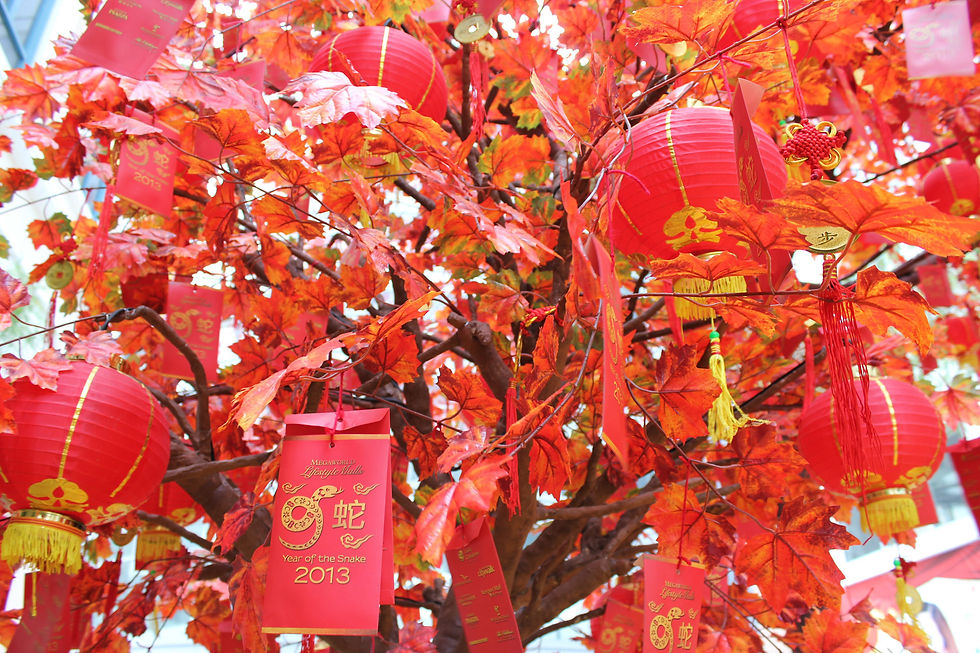
The celebration of the Chinese New Year includes the use of kumquat trees, which are commonly utilised for decoration and as gifts. Citrus fruits, including mandarins, are commonly linked to the Chinese New Year, and gifting fruits in even numbers is a culturally appropriate practice to prevent bad luck. Trees are integral to this celebration, as a substantial aspect of the holiday involves participants placing wishes on the branches of a sacred tree to encourage fulfilment in the upcoming months of the new year. Money trees are traditionally adorned with red envelopes that symbolise aspirations for the year, whereas the bamboo plant, which holds cultural significance, is presented to enhance future opportunities for favourable outcomes [6,7]. Tet Nguyen Dan, the Lunar New Year Festival in Vietnam, is the most significant holiday, marking the onset of spring and the new year. The planting of a New Year tree, or “Cay Neu,” is a Vietnamese tradition integral to the springtime Tet Festival. “Cay Neu” refers to a significantly tall bamboo tree that has been stripped of its leaves, retaining only a tuft at the apex. It is adorned with red paper symbolising good luck, while bows, bells, arrows, and gongs are suspended from the treetop to dispel the misfortunes of the previous year, while welcoming a joyful New Year for all [8].
Trees and plants in India play a pivotal role in cultural and spiritual traditions, with each species associated with distinct symbolism. Ugadi, recognised as the Hindu Lunar New Year, signifies the commencement of the new year and the arrival of spring in various South Indian states, including Karnataka, Andhra Pradesh, and Telangana. The neem tree is significant in this festival; its bitter flowers are essential in Ugadi Pachadi, a dish representing six flavours that symbolise various experiences and emotions of life [9]. Banana leaves are used in religious offerings and are made into biodegradable plates for festive meals, whereas mango leaves are hung across doorways in temples and homes during rituals to invite prosperity and good fortune. Sacred trees, which are ancient or situated in areas of spiritual significance, hold a revered status in Indian culture. Devotees tie colourful ribbons and strings along with various offerings to tree trunks as expressions of prayer or gratitude, thereby deepening the unique connection between humans and the natural environment. Ugadi signifies the onset of spring and commemorates the creation of the universe by the God Brahma. Mother Nature is believed to wake up from a long slumber and spread a blanket of greenery over the earth, giving it a new look by giving birth to new plants, shoots and leaves [10].
(Left) Ugadi Pachadi, a dish made with numerous ingredients derived from forest products, holds significance in the Hindu Lunar New Year (Photo: Pragnya Aindleni, CC BY-SA 4.0 <https://creativecommons.org/licenses/by-sa/4.0>, via Wikimedia Commons). (Right) In the Ugadi festivities, the Neem Tree (Azadirachta indica) represents life's inevitable bitter and sweet experiences with balance; hanging neem leaves at doorways symbolizes purification and protection. (Photo: Ton Rulkens, CC BY-SA 2.0 <https://creativecommons.org/licenses/by-sa/2.0>, via Wikimedia Commons).
Nowruz, also known as the Persian New Year, constitutes the most significant national celebration marking the onset of spring, reflecting the Iranian people's connection to nature, their beliefs, and cultural values. One tradition involves the preparation of a special table setting known as “Haft Sin,” which includes sabzeh (sprouted seeds of grain), samanu (paste made from minced green wheat, oil, almonds, etc.), sib (apple), serkeh (vinegar), sir (fresh garlic), sekkeh (coins), sonbol (hyacinth), somagh (a sour berry), and senjed (oleaster, or jujube fruits), siah-daneh (a fennel flower), sepand (seeds of wild rue that are placed in a dish and burned for good luck), and sabzi (green herbs) [11]. Most of the objects on the sofreh are meant to represent the earth and its place in the cosmos, the particular auspiciousness of the vernal equinox, charms for good fortune and the warding off of evil, the forces of rebirth and regeneration, and the good things in life one may enjoy in the new year [12]. The intricate web which ties forests to holiday celebrations is vast and important. This underscores the need to continuously preserve and protect our forests to ensure the continued traditions associated with them remain everlasting. As we prepare for the holiday season, let us continue to uphold environmental awareness and engage in eco-friendly celebrations that promote the sustainable utilisation of forests and forestry-related products. Happy Holidays and best wishes for the new year ahead!

References
[1] National Geographic History (2023, November 28). History of Christmas Trees - Symbolism, Traditions & Facts | HISTORY. HISTORY. https://www.history.com/articles/history-of-christmas-trees
[2] Steil, A. (2024). What types of Christmas trees are available? Iowa State University Extension and Outreach. https://yardandgarden.extension.iastate.edu/faq/what-types-christmas-trees-are-available
[3] Sanforestry (2024). The Role of Forestry in Holiday Traditions. https://sanforestry.com/2024/12/09/the-role-of-forestry-in-holiday - traditions/#:~:text=The%20tradition%20of%20bringing%20evergreen,and%20the%20promise%20of%20spring
[4] Matyukhina, O. (2022). Celebration of the New Year in Ukraine during the Soviet and post-Soviet periods. Łódzkie Studia Etnograficzne (1): 93-107. https://www.ceeol.com/search/article-detail?id=1080321
[5] Hamada, R. (2014). Japanese New Year Celebration. Manuscripts & Folklife Archives – Special Collections Library – Western Kentucky University.
[6] Dillon, K (2024). Why You Need Mandarin Orange or Kumquat Trees During the Chinese New Year. https://lajollamom.com/home-needs-mandarin-orange-kumquat-tree-chinese-new-year/
[7] Ward, L. (2018) "Chinese New Year". USU Student Folklore Fieldwork. Paper 537.
[8] Tran, R. (2021). "Cay Neu" & Its Meaning in Vietnamese Culture. https://vietnamdiscovery.com/culture-arts/cay-neu-lunar-new-year-pole/
[9] UGADI Festival (2025). https://mahabubnagar.telangana.gov.in/festival/ugadi-fesitival/
[10] Inamdar, V. and Chimmad, B.V. (2019). Traditional Festive Cuisine of North Karnataka. J. Hum. Ecol., 17(3): 233-236.
[11] Shobeiri, S. (2019). The Role of Rituals in the Design and Planning of Green Spaces – A Case Study: Tehran and the Persian New Year. Environment and Ecology Research 7(1): 19-42. DOI: 10.13189/eer.2019.070104
[12] Daniel, E. L. and Madhi, A. A. (2006). Culture and Customs of Iran, Westport, Conn. London, Greenwood Press.
Author biography
Dr. Sabrina Dookie is a lecturer and mangrove ecologist attached to the University of Guyana, Turkeyen Campus (Department of Biology). Her research interests include mangrove restoration, microbial functionality in mangroves, ecophysiological adaptions of mangroves in stressed environments, coastal and marine life management, hydroperiod and sedimentation dynamics, sustainable forestry management, and traditional ecological knowledge and its applications.


Comments