

Hidden impacts of ash dieback – what is happening to our carbon stocks?

Written by Rachel Mailes (guest writer)
Watching for roots, uneven ground, and other trip hazards, I remind myself to look up often; trees are what I am here for. Coming to a crossroad in the path I see it. The reminder of why this work is important. Taking the path on the left, I duck under some brambles climbing their way up the trees lining the path and emerge out into a clearing. It’s beautiful, full of long grass and tall flowering thistles that have attracted more butterflies than I have seen in one place for a long time. Red Admirals, Painted Ladies and Small Tortoiseshells wing their way lazily across the tall grass and back into the trees. It would be perfect.
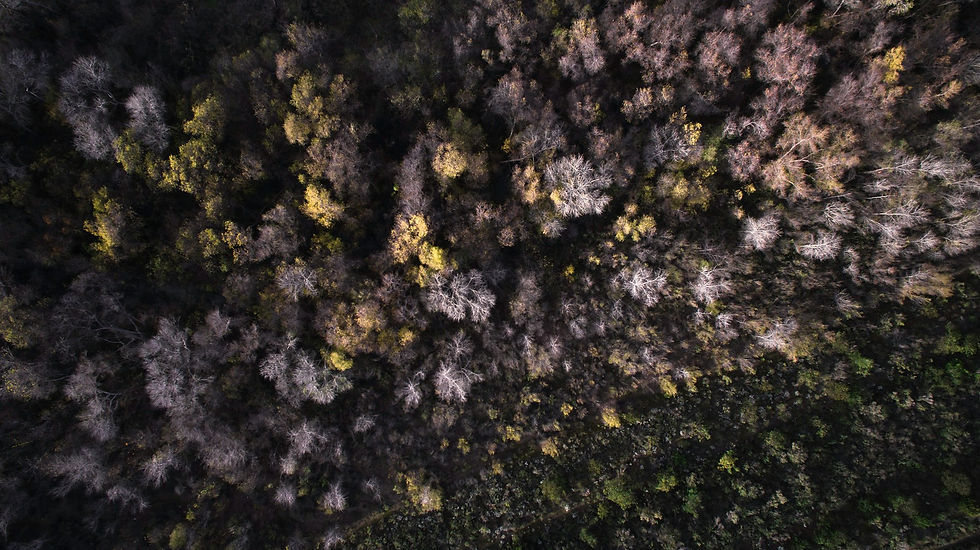
Except I can see the large swathes of skeletal canopy on the other side of the clearing - dead ash. Often found growing in groups, the lack of foliage and clear sky behind bare branches makes them easy to pick out amongst the flush of green oaks and beech. It’s the middle of summer, the ash trees should also be full of leaves, absorbing light for photosynthesis. But this skeletal scene is found all over Europe, like a forest holding its breath, as Ash Dieback disease, among other pressures, is causing widespread deaths in ash populations.

The disease, ash dieback (Hymenoscyphus fraxineus), is caused by a fungi that effects the leaves and small twigs of the trees causing canopy dieback and preventing the trees from producing enough energy to survive [1,2]. The disease also can damage the xylem of the tree, responsible for water transfer up and down the tree trunk, and produce a symptom called stem girdling, making transport of nutrients from one part of the tree to another difficult [3].
For the last four years, myself and other scientists from Treescapes project MEMBRA have investigated the changes in mortality and carbon stocks in UK ash populations since 2012, the first official case of ash dieback in the UK [5]. We tried to understand which environmental variables may increase or decrease the resilience of an ash tree against dieback disease.

Our study has found that despite 99.7% of trees being infected, ash populations have in fact not suffered from increased mortality rates and that carbon stocks have continued to grow since the introduction of ash dieback. However, before we get too excited about this finding, it is important to remember that the data may simply be revealing a ‘lag phase’ wherein large trees have become infected but not yet succumbed to the disease. This is also the expectation from other studies, which suggest that up to 70% of ash trees will eventually be lost to dieback as the disease progresses [5]. So far, with around 10 years of infection at our sites, we found that on average, one third of all ash trees surveyed had already lost more than 75% of their canopy and thus are unlikely to recover from the disease. Therefore, our data suggests that nearly 30% of the carbon within these ash populations is likely to be returned to the atmosphere in the near future, constituting ‘carbon debts’ to this long-lasting but fatal diseases. This begs the question, that while our ash trees still stand, are they hiding a carbon loss already occurring? And how are we accounting for this in carbon policy?
Our results highlight how understanding tree disease dynamics can influence practice and carbon calculation projections. Leaving the ‘carbon debt’ from disease out of carbon projections can lead to overestimates of forest carbon stocks, with far greater amounts of dead biomass, releasing carbon back to the atmosphere within the forest than are accounted for in models.

We found one more worrying aspect of this story. In another study, our data shows that UK forests seem to be struggling to produce new young trees to replace the old ones that die, a process called regeneration. While disease likely plays only a small part in the observed declines, the reduction of new trees growing up to replace old ones within UK forests is concerning for many reasons, including the fact that unlike with past diseases such as Dutch Elm disease (Ophiostoma novo-ulmi), very little is growing back as ash are lost. If these patterns continue, they could have great consequences for the future of our woodlands and the plants and creatures that rely on them.
However, there is still hope for our ash populations as we found positive effects of mixed, open canopy forests for the health of these trees. Access to light and less ash neighbours also reduced the severity of infection and the likelihood of infected trees dying. Therefore, these results, as others [3,7,8] suggest that thinning the most infected individuals in stands of ash may help increase the resilience of remaining trees due to the increased access to light and decreased numbers of conspecific neighbours. Large trees were also less likely to be severely infected, meaning we still have a window of time to act and find solutions to the problems of regeneration before we lose the large, old ash from our woodlands and threaten the 953 species of plants and animals that rely on them [6].
To find out more check out MEMBRA’s papers and project here:
Regeneration Decline Paper – https://www.sciencedirect.com/science/article/pii/S0378112725009764
Regeneration Decline Guardian Article - https://www.theguardian.com/environment/2025/jul/10/britain-ancient-woodlands-failing-regenerate-forests-climate-drought-heat-disease-deer-hope-aoe
What do trees remember blog - https://theconversation.com/what-do-trees-remember-268499
MEMBRA Project – https://membra.info/
References
[1] Baral, H.-O., Queloz, V., Hosoya, T., 2014. Hymenoscyphus fraxineus, the correct scientific name for the fungus causing ash dieback in Europe. IMA Fungus 5 (1), 79–80. https://doi.org/10.5598/imafungus.2014.05.01.09.
[2] Gross, A., Holdenrieder, O., Pautasso, M., Queloz, V., Sieber, T.N., 2014. Hymenoscyphus pseudoalbidus, the causal agent of European ash dieback. Mol. Plant Pathol. 15 (1), 5–21. https://doi.org/10.1111/mpp.12073.
[3] Combes, M., Webber, J., Boddy, L., 2024. Current understanding and future prospects for ash dieback disease with a focus on Britain. For. Int. J. For. Res. https://doi.org/ 10.1093/forestry/cpae040.
[4] Plumb, W.J., Coker, T.L.R., Stocks, J.J., Woodcock, P., Quine, C.P., Nemesio-Gorriz, M., Douglas, G.C., Kelly, L.J., Buggs, R.J.A., 2020. The viability of a breeding programme for ash in the British Isles in the face of ash dieback. Plants People Planet 2, 29–40. https://doi.org/10.1002/ppp3.10060.
[5] Coker, T.L.R., Rozsyp´alek, J., Edwards, A., Harwood, T.P., Butfoy, L., Buggs, R.J.A., 2019. Estimating mortality rates of European ash (Fraxinus excelsior) under the ash dieback (Hymenoscyphus fraxineus) epidemic. Plants People Planet 1, 48–58. https://doi.org/10.1002/ppp3.11.
[6] Mitchell, R.J., Beaton, J.K., Bellamy, P.E., Broome, A., Chetcuti, J., Eaton, S., Ellis, C.J., Gimona, A., Harmer, R., Hester, A.J., Hewison, R.L., Hodgetts, N.G., Iason, G.R., Kerr, G., Littlewood, N.A., Newey, S., Potts, J.M., Pozsgai, G., Ray, D., Woodward, S., 2014. Ash dieback in the UK: a review of the ecological and conservation implications and potential management options. Biol. Conserv. 175, 95–109. https://doi.org/10.1016/j.biocon.2014.04.019.
[7] Cracknell, D.J., Peterken, G.F., Pommerening, A., Lawrence, P.J., Healey, J.R., 2023. Neighbours matter and the weak succumb: ash dieback infection is more severe in ash trees with fewer conspecific neighbours and lower prior growth rate. J. Ecol. 111, 2118–2133. https://doi.org/10.1111/1365-2745.14191.
[8] Enderle, R., Stenlid, J., Vasaitis, R., 2019. An overview of ash (Fraxinus spp.) and the ash dieback disease in Europe. CAB Rev. Persp. Agricult. Vet. Sci. Nutr. Nat. Res. 14 (25). https://doi.org/10.1079/PAVSNNR201914025.
About the author
Rachel Mailes is a PhD Researcher in Earth & Environmental Science at the University of Birmingham.
Comments