

What if Death in Forests is Just Another Beginning?

Updated: Aug 31
Understanding forest life beyond growth, decay and endings
Written by Sunandani Chandel
I once thought a fallen tree marked the end of a forest story, a silence in structure, a break in continuity. But forests rarely align with human understanding of endings. What falls doesn’t disappear; it reorganizes.
Walking through deadwood, I began to notice something I had overlooked before: small signs of life returning to what seemed lost. Seedlings emerging from decaying logs, moss spreading across fractured bark, fungi quietly rebuilding what was once whole. In that space, forests no longer appeared as systems moving from life to death, but as continuous cycles where life keeps beginning.
As wood softens and returns to soil, it does not stop functioning. It shifts into another ecological state - one that continues to structure biodiversity, regulate nutrients, and support regeneration.
“What we call the beginning is often the end. And to make an end is to make a beginning. The end is where we start from.”— T. S. Eliot
To understand this transformation not as a metaphor but as an ecological structure, we need to look more closely at what we call “deadwood”.

What is deadwood?
At first glance, it may appear inactive or abandoned. But in forest ecology, this view is incomplete. Deadwood includes standing dead trees (snags), windthrown logs, broken branches, stumps, and veteran trees. Importantly, it does not begin only at death - it forms gradually, often while the tree is still alive, through damaged limbs, decay pockets, or structural injury.

Rather than a static object, deadwood is a dynamic habitat in transition, shaped by ongoing biological and chemical processes. It forms a system where:
Physical structure persists for decades to centuries
Biological communities assemble in succession
Carbon and nutrients are gradually redistributed
Habitat conditions shift across stages of decay
Its importance becomes clearer when we move beyond definition and into the hidden ecological processes unfolding within it.
A hidden succession system within decay
A forest’s richest life is not always in green canopies. Often it is hidden in what we overlook - the hollow log, the fallen trunk, the slow return of wood to soil.
Life exists not only where trees stand tall, but also where they break down.
What seems still, in reality, is a part of quiet spaces rich in ecological sequence. Fungi spread through wood like memory, insects carve passageways through softened layers, mosses blur the edges of decay, and regeneration begins long before anything is visible.
What looks lifeless is often one of the most biologically active parts of the forest.
Science consistently shows this is not a metaphor - it is a structure. Tree mortality triggers a cascade of ecological processes: microbial colonisation, fungal decomposition, saproxylic insect recruitment, nutrient release, microsite formation, and finally seedling establishment.
Yet despite this complexity, deadwood is often treated in management as material to be removed rather than retained.
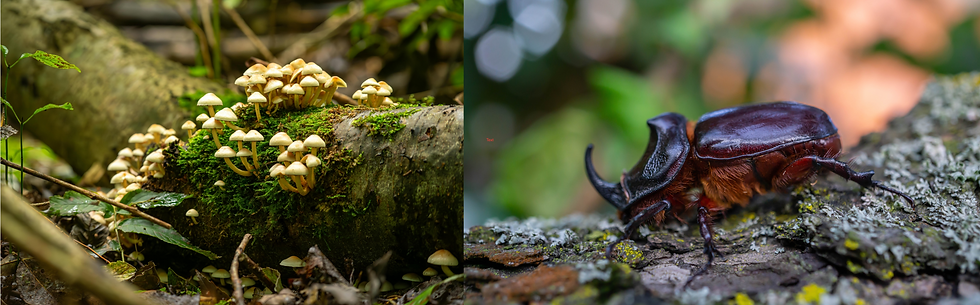
Hidden biodiversity in plain sight
In managed forests, deadwood is frequently removed or fragmented, quietly reducing the continuity many species depend on. What is often called “cleaning” a forest is, in ecological reality, a removal of habitat complexity [1].
This matters because deadwood is not a minor component of biodiversity—it actively structures it. It plays a critical role in supporting the soil microarthropods diversity among forest ecosystems, which in turn influences trophic structure and overall ecosystem stability [2].
Time is also embedded within wood. In near-natural boreal forests, 331 standing dead pine trees revealed a 275-year chronosequence since death. Each stage supported distinct lichen communities, showing how decay itself creates long-term habitat continuity [3].
This shifts our understanding fundamentally.
Forest death is not termination; it is an extended ecological function. In forests, death is not an ending; it is another form of life.
Chemical communications in decay ecosystems
Deadwood is often seen as what remains after life has ended. But forest ecology reveals something quieter and more continuous.
Fallen trees remain active within ecosystems through decomposition shaped by climate, microbes, insects, moisture, and chemical signaling. Even decay has direction and structure.
As wood breaks down, it releases volatile organic compounds (VOCs) that guide saproxylic beetles toward suitable habitats [4]. In this sense, the forest communicates even in decay, and life responds.
Decay is not silence. It is communication. It shapes who arrives, who stays, how communities assemble, and how regeneration begins.
Deadwood as long term habitat structure
One of the most overlooked features of deadwood is its longevity. Depending upon species and climate, it can function as a habitat for decades to centuries, supporting sequential ecological communities over time [5].
As decay progresses:
Early stages support wood-boring insects and pioneer fungi
Intermediate stages increase microbial and invertebrate diversity
Late stages integrate into soil systems as humified organic matter
Across these stages, deadwood is not static. It is a continuously evolving habitat system. What appears as decay is, in reality, a gradual transformation where woody debris becomes part of the soil, building organic matter and humus over time.

Why deadwood matters for forest ecosystems?
Deadwood is not simply carbon stored or released, or nutrients returning to soil, or habitat slowly unfolding for countless organisms. It is a core driver of forest ecosystem functioning.
It regulates carbon cycling through gradual release and stabilization of carbon pools, nutrient regeneration via slow mineralization into soils, enhancing biodiversity by providing habitat for saproxylic fungi, insects, and microorganisms, and creates regeneration niches for seedlings. It also contributes to hydrological buffering by retaining moisture and stabilizing forest floor conditions.
Despite this, deadwood remains frequently undervalued in forest management, raising an important question:
If deadwood is so central to forest function, how do we treat it in practice?
From removal to retention: changing forest perspectives
Forests are often judged by what stands upright - trees, canopy cover and visible growth. But what about what has fallen?
Historically, deadwood was removed under “forest hygiene,” mainly to protect timber. But over the last few decades, ecological understanding has shifted. Removal is now recognised as reducing biodiversity and weakening ecosystem resilience. However, practices still vary widely. In many tropical forests, burning remains a method of clearing logging residues, which can disrupt long-term ecological processes.
Today, deadwood is increasingly recognised as a structural and functional component of forests.
Frameworks such as the UK Forestry Standard, State of Europe’s Forests 2025, and European Union Biodiversity Strategy for 2030, and certification systems such as the Forest Stewardship Council (FSC) and the Programme for the Endorsement of Forest Certification (PEFC) all highlight its importance in maintaining habitat complexity and ecosystem integrity. Scientific tools like the USDA Forest Service “DecAID Advisor” further support the evidence-based decisions making in forest management.
At a global scale, assessments like FAO Global Forest Resources Assessment 2025 highlight deadwood’s contribution towards carbon storage, nutrient cycling, and biological diversity.
Together, these developments signal an important transition from removal toward retention. The discussion is now not whether deadwood matters, but how much should be retained, in what forms, and across which stages of decay within managed forests.
This also challenges a deeper assumption in forest thinking.
Where do we draw the line between what is considered a forest and how we define endings within forest ecosystems?
When Forests Refuse to End
Deadwood reminds us that nothing in a forest truly ends; it only changes form.
What falls quietly becomes the ground for new life, shaping unseen cycles of growth and renewal. In decay, forests are not breaking down but building forward in silence.
So perhaps the real question is not what the forest loses when trees fall, but what forms of life begin that we are still unable to see when we call it “death”.
A forest is not defined by what stands above ground, but by what it continues to become after it falls.
References
[1] Özdemir, S., Yavuz, M. & Kahriman, A., 2026. Comparative analysis of deadwood abundance and characteristics in protected versus managed forests in Northeastern Turkey. Journal of Forestry Research. Available at: https://link.springer.com/article/10.1007/s11676-026-02028-9.
[2] Zhang, Y., Junggebauer, A., Pollierer, M.M., Scheu, S. & Zhou, Z., 2025. Contrasting effects of deadwood and gaps on the trophic structure of forest soil microarthropods. Functional Ecology, 40(1), pp.150–162. Available at: https://doi.org/10.1111/1365-2435.70228.
[3] Nirhamo, A., Santos, P., Günther, M., Kouki, J. & Aakala, T., 2026. Community dynamics of lignicolous lichens on standing deadwood in a 275-year chronosequence. Oikos. Available at: https://doi.org/10.1002/oik.11835.
[4] Sbaraglia, C., Thorn, S., Ambrožová, L., Čížek, L., Kozel, P., Rodríguez-León, D.S., Schmitt, T. & Drag, L., 2026. The potential role of volatile organic compounds on the colonisation of deadwood by saproxylic beetles. Oecologia, 208, 38. Available at: https://link.springer.com/article/10.1007/s00442-026-05874-w.
[5] Steinebrunner, F., Tischer, A., Medicus, T., Huth, F. & Bernhardt-Römermann, M., 2025. The effects of deadwood on tree regeneration and microsites: A systematic review. Forest Ecology and Management, 596, 123096. Available at: https://doi.org/10.1016/j.foreco.2025.123096.
About Author
Sunandani Chandel is a PhD research scholar in Forestry (Forest Products and Utilization) at Kerala Agricultural University, India. Her work focuses on the sustainable management and value addition of forest resources, with interests in tropical forest ecology, biodiversity conservation, and climate mitigation. Alongside her research, she has a strong passion for forest education writing, where she aims to communicate ecological ideas in a simple and engaging way, helping readers understand forests as dynamic systems.


Comments