

Beyond Planting Trees: What Climate Change Means for Mangrove Recovery

Written by Sabrina Dookie
In Guyana, mangroves are the first line etched between the coast and the Atlantic Ocean. In my mind, I see them as silent soldiers which protect our low-lying populations against flooding and erosion from the thunderous waves bombarding our 459 km coastline every single day.
They grow. They protect. They nurture.
Growing up, I thought they would always be there until I witnessed sections of the forest disappearing as the years went by. In some sections, the trees are barely left holding on, showing a slow kind of stress marked by skeletons of dead trees all standing in a cemetery- like macabre.
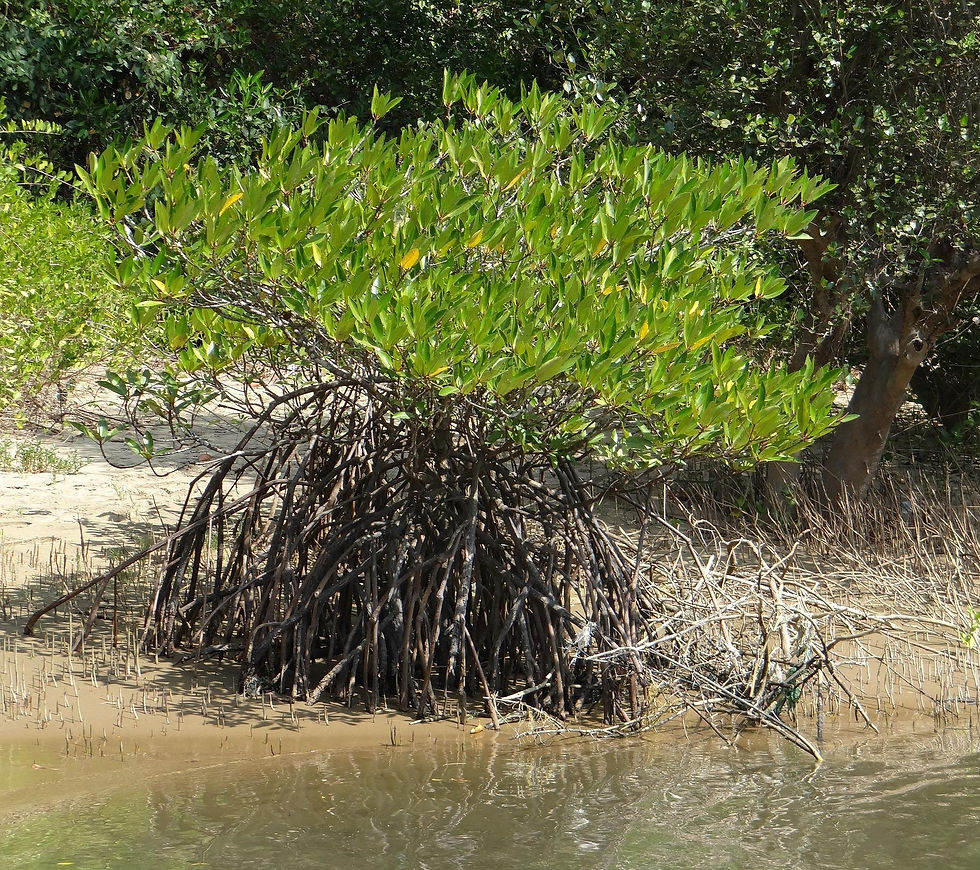
Some of them with their gnarled trunks, brittle branches, and twisted, exposed roots leaning and twisting towards each other as if holding hands in a slow, melancholic waltz.
The dance of the dying mangroves.

They were many times we had attempted to replant some areas with some successes and some failures. One day, a thriving forest holding the coast. The next, just open water where the roots used to be.
These forests have persisted for centuries and were described since the 15th century as sentinels of resilience during Sir Walter Releigh’s exploration of the Guianas [1].
So, why are they falling apart in my lifetime?
Climate change’s quiet assault: a steady character at play
Climate change moves like a figure in the mist, shrouding everything it touches, changing the rules. The waters become warmer. The tides shift, drowning the seedlings.
The soil turns against the roots making them weaker and more vulnerable. They are strangled by salinity spikes, pollutants, and effluents from booming industries [2].
Eventually, the forests struggle to find their inherent rhythm which propels life within and around them.
The forest doesn’t fall in a day.
It slowly buckles under the weight of this shroud. Even when we replant, this shroud doesn’t lift.
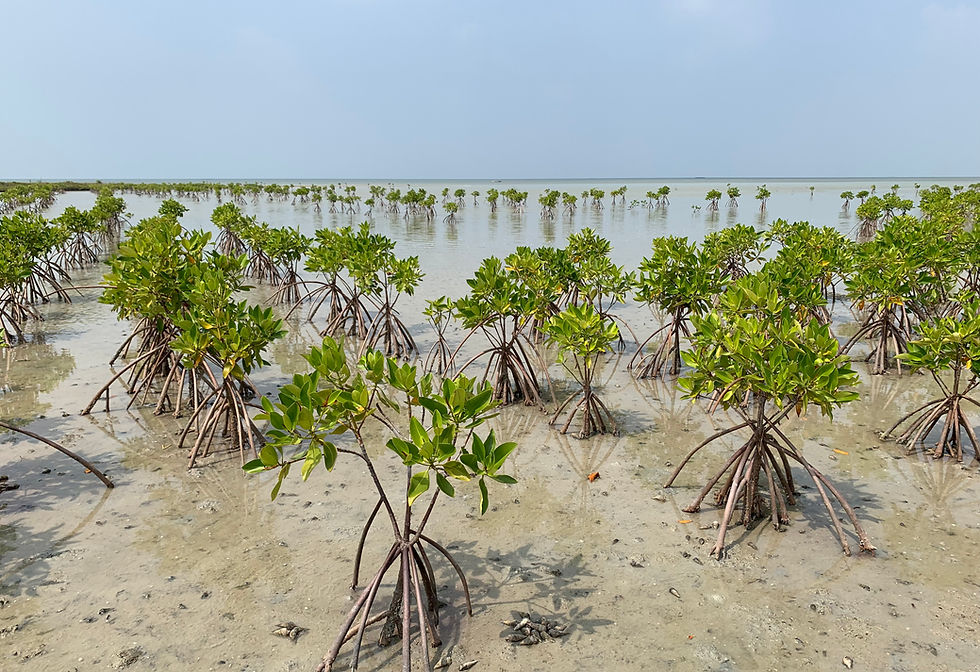
The seedlings go into the ground and, without properly taking root, the environment rejects them as fast as we plant them. This is the familiar story.
On climate change, mangroves, and adaptation: most countries sing the same tune.
Standing in the face of climate change – moving forward and gaining ground
But here is the twist - while some mangroves are still dying, others are expanding. A 2026 study conducted by Zhen Zhang and colleagues found that global mangrove cover is showing signs of recovery worldwide [3]!
Losses are largely offset by regrowth and expansion through natural regeneration, restoration efforts, and expansion into newly formed areas as a result of changing environmental conditions such as warmer temperatures.
More surprisingly, the naturally existing forests are becoming denser and healthier.
However, the recovery is uneven as humans continue to tip the scale, making it harder for the forests to hold themselves up.
Deforestation for agriculture and industrial development remains a threat in several regions, and the process is far from complete.
Mangrove recovery: A puzzle with moving pieces
Rare mangrove conservation success stories always present a case of optimism for climate action.
But the real lesson is how the pieces of this puzzle fit together over time. How do we get these pieces to align?
Mangrove recovery is like a rope, not a thread. We cannot pull a forest back into its original state with one strand. Optimum environmental conditions such as roots, salinity regimes, tides, sediments, and climate stability must be braided together.
If we rely solely on one alone, then that thread snaps. Together, they rip that heavy shroud apart and become more resistant to its persistence over time.

The ecosystems change and so they adapt. Over time, they evolve. The same principle applies to us.
Mangrove recovery failures aren’t inevitable; it is a signal that some strands which connect us to the forests are missing.
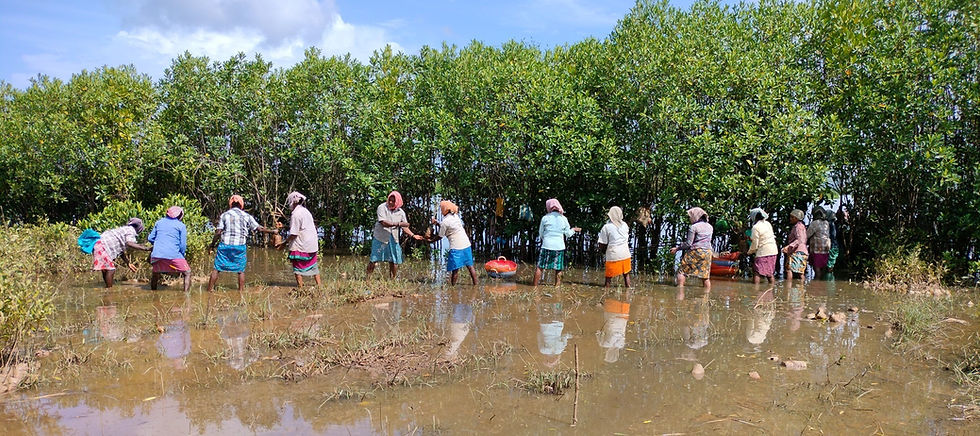
When local communities, scientists, and policymakers contribute to effective management and monitoring, these efforts are braided together- creating more conditions for conservation success stories in a changing climate.
References
[1] Raleigh, W. (1596). The discouerie of the large, rich, and bevvtiful empyre of Guiana: With a relation of the great and golden citie of Manoa (which the Spanyards call El Dorado) and the prouinces of Emeria, Arromaia, Amapaia, and other countries, with their riuers, adioyning. Robert Robinson. [STC (2nd ed.) 20636].
[2] Li, M., Ishfaq, M., González Quintero, V. A., Peng, D., Lang, T., Gao, C., Tam, N. F., & Zhou, H. (2025). Impact of elevated environmental pollutants on carbon storage in mangrove wetlands: A comprehensive review. Ecological Indicators, 178, Article 113830. https://doi.org/10.1016/j.ecolind.2025.113830.
[3] Zhang, Z., et al. (2026). Unexpected expansion and regrowth in Earth's mangrove forests over the past four decades. Science, 392(6798), 1082–1087. https://doi.org/10.1126/science.aec9773.

About the Author
Dr. Sabrina Dookie is a lecturer and mangrove ecologist attached to the University of Guyana, Turkeyen Campus (Department of Biology). Her research interests include mangrove restoration, ecophysiological adaptations of mangroves in stressed environments, ethnobotany, hydroperiod and sedimentation dynamics, and sustainable forestry management.

Comments