

Mangrove Restoration: Simple When Done Right, Complex When Done Wrong
- Guest Writer

- Jul 13
- 4 min read
Written by Mayur Fulmali (Guest Writer)
“A tiny herb thrives through concrete in scorching heat, while many pampered garden plants give up after one extra watering.” Growing plants can be difficult if not done correctly, and when the scale expands from a small garden to many hectares of land, uncertainty only increases.
Yet, when Mother Nature takes charge, even a tiny herb can thrive in unimaginable places.
It seems logical to simply follow nature's lead. However, identifying the key factors responsible for successful plant growth from a range of seemingly ‘right conditions’ is far from straightforward.

The idea of growing trees to combat climate change is an old idea. While it may sound simple, the technicalities involved are more complex. Ecosystem restorations are expensive, and failures can discourage funders, practitioners, and local communities alike.
Therefore, understanding the processes and challenges of restoration is crucial [1,2]. Mangroves are among the most valuable coastal ecosystems. They support livelihoods, protect shorelines, store carbon and conserve biodiversity.
Although mangrove forests have experienced significant losses worldwide, recent reports suggest gains in forest cover in some regions.
As a result, mangrove restoration is fundamental for climate mitigation and ecosystem function [2].
Why is mangrove restoration difficult?
Bringing back a degraded ecosystem to its former natural condition is the main goal of restoration.
However, in a constantly changing world, defining a "natural condition" can be quite challenging. A nearby reference forest often serves as a benchmark, but in its absence, imagining a former natural state becomes difficult.
Before any intervention, it is important to have a clear vision of what the restoration site should look like and its success should also be defined [2].
It is also important to understand why mangroves are not growing in the first place.
Factors such as inadequate tidal flow, high salinity, reduced freshwater supply, seed unavailability, herbivory, unsuitable soil, and water conditions can all prevent mangrove establishment [1].
Acting individually or together, these factors determine whether restoration efforts succeed or fail.
Mangrove ecosystems are often located close to communities and areas of high economic activity. This creates competition for land, leading to logging, land conversion, and habitat degradation.
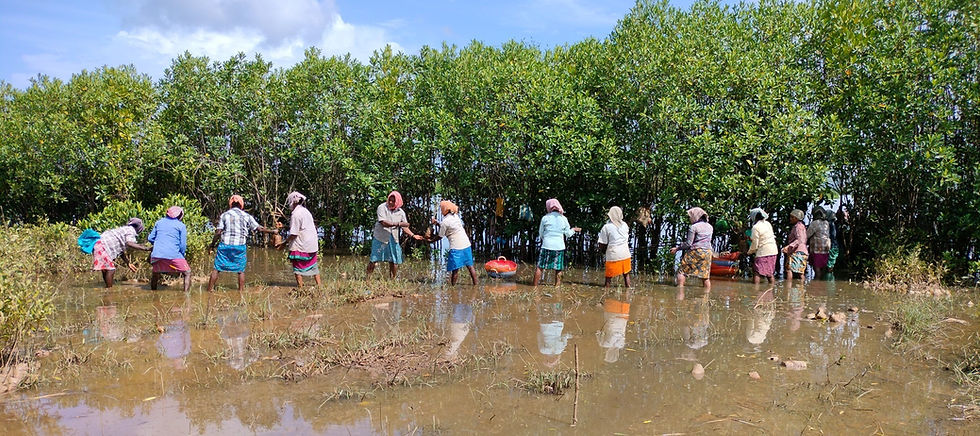
The relationship between socio-economic development and mangrove conservation can be complex. Yet, local communities frequently support restoration activities when the need and benefits are clearly shown [3].
Ultimately, successful restoration is not only about restoring trees and tidal flows. It is about balancing ecological goals with the needs of people who depend on these ecosystems.
Simple things can make or break restoration
Can a tomato plant be grown on the seafloor?
As absurd as that sounds, the analogy works well when explaining the importance of site selection.
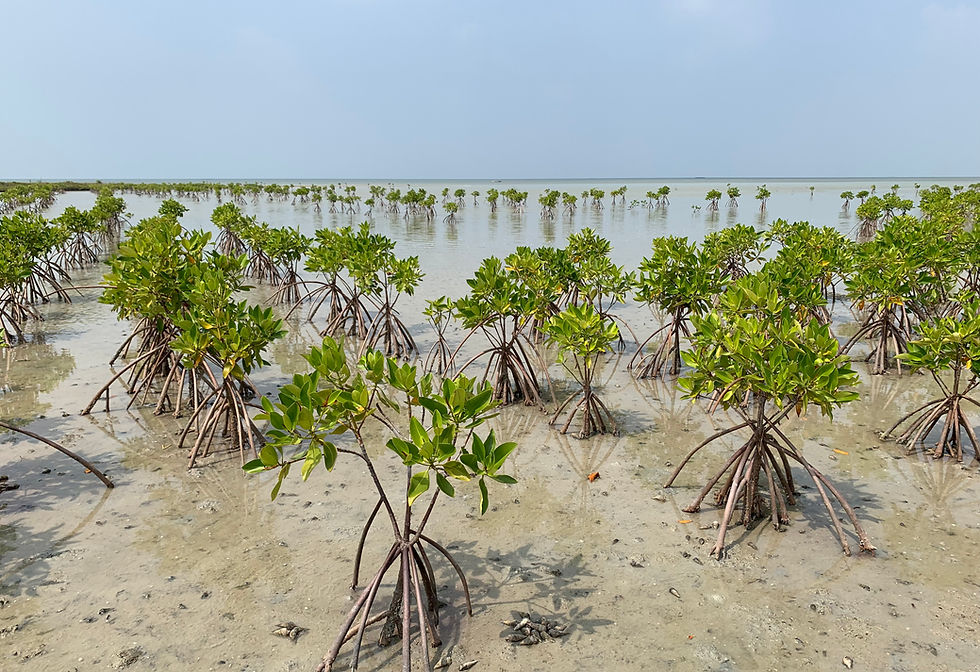
A suitable restoration site should have unrestricted tidal exchange. The tides bring oxygen, nutrients, and sediments essential for mangrove growth.
Restricted tidal flow can increase soil salinity and stress on mangroves, which can also lead to poor water movement, causing hypoxic conditions [2].
Species selection is equally important. Each mangrove species occupies a distinct zone within the intertidal habitat.
For example, Rhizophora spp. thrive along seaward edges and are adapted to frequent flooding, but species such as Lumnitzera spp. & Ceriops spp. are better suited to less flooded areas (Figure 2). Planting particular species in unsuitable habitats often leads to low survival [1,2].

If tidal inundation stops, restoring water connectivity is often the first step. In India, a common approach involves excavating "fish-bone channels" that reconnect isolated areas to tidal waters.
Once tidal flow is restored, mangrove seedlings can be planted under better conditions [2,4]. The trade-off is that changing this water flow can drastically harm other coastal plants.
“Often, the upper tidal regions occupied by salt marshes become victims of mangrove restoration through fish-bone channels. These areas don’t have natural tidal inundation except for the monsoonal tides or rare spring tides,” said Dr. Nehru Prabakaran, a coastal and marine scientist at the Wildlife Institute of India.

Another simple consideration is the location of the nursery.
Would a mangrove seedling raised in Okinawa thrive in the Sundarbans?
Probably not.
Seedlings become adapted to the environmental conditions in which they are raised. When they are transplanted into a very different area, survival may decline.
Establishing nurseries close to restoration sites allows seedlings to acclimatise to local conditions and better withstand transplantation stress [2].
Learning lessons from the beginning
As an early-career researcher, one thing I have learned is that restoration is not as simple as merely planting seedlings in the ground.
The more I learn, the more I realise that understanding the site, the species, and the reasons behind degradation is often more important than the act of planting itself.
Planting seedlings is the headline. Understanding the ecosystem is the story which makes it last.
References
[1] Ellison, A. M. (2000). Mangrove restoration: do we know enough? Restoration ecology, 8(3), 219-229.
[2] Zimmer, M., Ajonina, G. N., Amir, A. A., Cragg, S. M., Crooks, S., Dahdouh-Guebas, F., ... & Wodehouse, D. (2022). When nature needs a helping hand: Different levels of human intervention for mangrove (re-) establishment. Frontiers in Forests and Global Change, 5, 784322.
[3] Su, J., Friess, D. A., & Gasparatos, A. (2021). A meta-analysis of the ecological and economic outcomes of mangrove restoration. Nature communications, 12(1), 5050.
[4] Lewis III, R. R. (2005). Ecological engineering for successful management and restoration of mangrove forests. Ecological engineering, 24(4), 403-418.

About the author
Mayur Fulmali is a doctoral student at the Wildlife Institute of India, with research interests spanning mangrove restoration ecology, mangrove crab ecology, functional diversity, coastal squeeze, plastic litter impacts, and island ecosystems. His work focuses on understanding how ecological processes shape the structure and functioning of coastal ecosystems and how science can inform effective conservation and restoration practices.

Comments